
Was It Really an Accident?
The Truth About Toddler George's Death

If you have read my recent post, What They Couldn't Have Known, you will already know the story of Annie Greene/Green and the remarkable life she lived after that violent December night in 1844 at Bath-court, Shoreditch. But Annie's story has a shadow that runs beneath it, one that begins before the police raid, before the Old Bailey trial, and before her father Thomas Green was transported to Van Diemen's Land. It begins with a younger brother she would have known for just nineteen months. His name was George, he lived in the same dangerous rooms, breathed the same acid-tinged air, and paid the ultimate price for his parents' criminal choices.
This is his story.
The following report appeared in Bell’s New Weekly Messenger, 28 July 1844:
Poisoning by Oxalic Acid. — A very fine child, two years old, named George Green, whose parents live in Bath-street, Shoreditch, was destroyed a few days since by swallowing oxalic acid. The father, who is a shoemaker, was at work at his bench, and had beside him a phial containing a quantity of the acid in solution, for use in his trade, but having left the shop for a minute, the child, who was playing about the bench, got hold of the phial, and had just swallowed the contents as the father returned. The child expired before any antidote could be administered. An inquest has been held on the body and a verdict of “Accidentally poisoned” returned. 1
It is a short report, but it speaks volumes.
A Family Living on the Edge
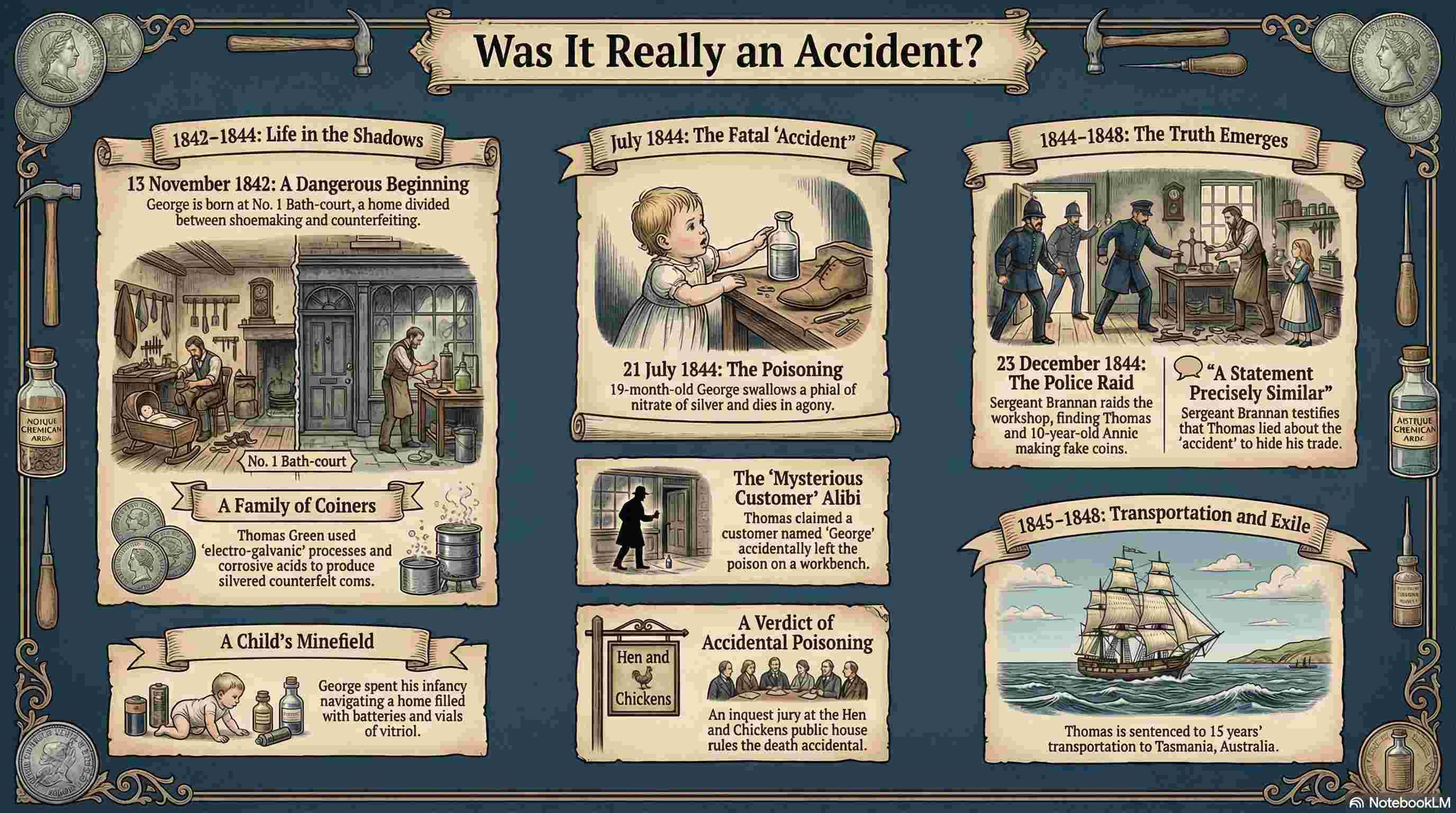
In the two-room dwelling at No. 1 Bath-court, the air carried two different lives. Downstairs, it smelled of tanned leather and shoe wax; upstairs, it bit the throat with the metallic tang of sulfuric acid. It was into this divided world that George Green was born on 13 November 1842, in the crowded, soot-stained streets of Shoreditch.
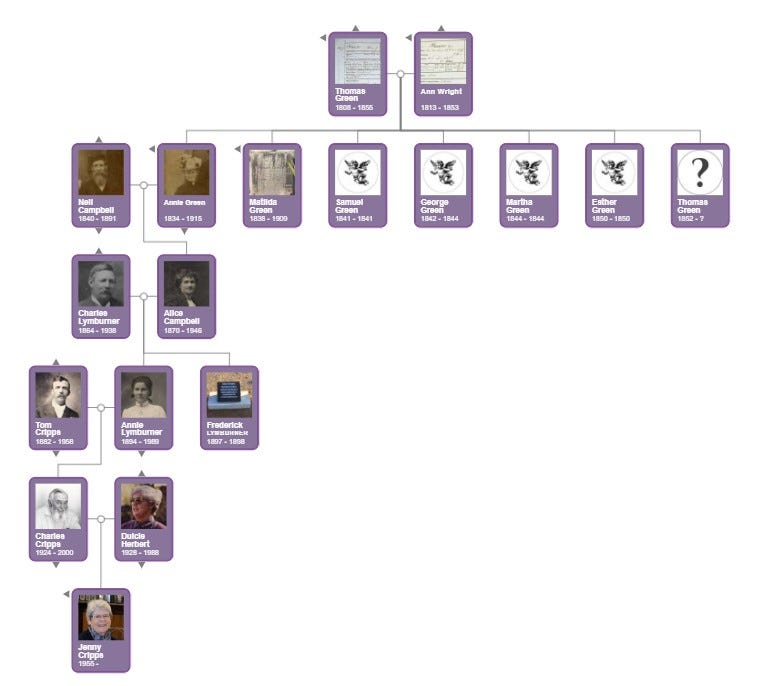
George was not the first to brave this environment. His elder sister, Annie, had been born in Dublin in 1834 before the family crossed the Irish Sea to settle in London’s East End. Another sister, Matilda, followed in 1838. There had been a brother, too: Samuel Fergus, but he had lasted only four months before “inflammation of the lungs“ claimed him in 1841. By the time George was a toddler, his parents, Thomas and Ann, were no longer merely struggling workers; they were deeply entrenched in a sophisticated criminal enterprise.
A Father’s Dangerous Trade
Thomas Green maintained the facade of an honest shoemaker. However, his upstairs workshop was fitted not for cobbling, but for the “electro-galvanic“ process of silvering counterfeit coins. The room was filled with workbenches, galvanic batteries, and glass phials of vitriol and nitrate of silver.
This was a family business in the most harrowing sense. While Thomas finished the base-metal shillings sent to him by the gang, his young daughter who was barely 10 years old, was already being tutored in the trade. His wife, Ann (who alternated between the surnames Green, Wright and Winter), spent her days “uttering,” passing the fake currency into the legitimate economy. In this house, crime was not a choice; it surrounded George’s infancy.
A Toddler in a Volatile Home
George spent his brief life navigating a minefield. As he learned to crawl and eventually walk, he did so among bottles of corrosive liquids that could blind or kill. The “small way of business” Thomas claimed to run was a volatile mix of poverty and poison.
Infant mortality was an everyday reality of the 1840s, a grim reality of the Shoreditch slums. But while his brother Samuel had been taken by the damp London air, the danger George faced was bottled and sitting on a workbench.
Sunday, 21 July 1844
On a humid Sunday afternoon, when George was just 19 months old, the family’s two worlds collided. According to Thomas, a customer named “George” had left a four-ounce phial on the leathern seat while waiting for a boot repair.
In the early afternoon, Thomas walked toward the yard. Little George followed, his eyes catching the glint of the glass. Before his father could intervene, the toddler seized the bottle and drank. The reaction was instantaneous. The child’s screams echoed through Bath-court as the nitrate of silver (a caustic poison used to coat coins) began to burn his throat. Thomas rushed the boy to a nearby surgery, but the damage was absolute. George Green survived only a few minutes, dying in a state of agony that no antidote could reach.
The Inquest: A Convenient Truth
Two days later, an inquest was held at the Hen and Chickens public house. The jury listened to Thomas’s account of the mysterious customer and the forgotten phial. The surgeon confirmed the cause of death: accidental poisoning.
Whether the jury believed the story or simply lacked the will to challenge a grieving father in a district where children died every day, we cannot know. They returned a verdict of “Accidentally poisoned from drinking a solution of nitrate of silver.”
George was buried in Shoreditch, his death certificate briefly noting him as the “Son of Shoemaker Thomas Greene.” The world moved on, but the police were watching. 2 3
The Raid at Bath-court
The “accident” did not slow the Green family’s industry. Several months later another tragedy had struck; a new sister, Martha, was born 6 November 1844, but she died just fifteen days later from “debility from birth”, her constitution likely too weak to survive the harsh conditions of the East End.
On the evening of 23 December, the law finally caught up with them. Led by Sergeant Brannan, the police forced their way in and stormed the upstairs workshop. They found Thomas and young Annie surrounded by a sea of counterfeit coins and galvanic batteries. The scene was one of fierce resistance. Thomas kicked Brannan down the stairs and hurled vitriol at the officers.
Young Annie, displaying a ferocity “scarcely credible for a child of such tender years,” fought to hide bags of coins in her skirts. The newspapers later described her as a “determined little vixen” for the way she battled the constables. Even the family bulldog joined the fray, snapping at the officers. It was a glimpse into the life George would have inherited: a violent, desperate loyalty to a losing cause.
The Sergeant’s Accusation
During the subsequent legal proceedings, the “accidental” nature of George’s death was called into chilling question. According to the newspaper account of his testimony, Sergeant Brannan testified that he believed the story of the customer was a lie. He asserted that the child had died from the very liquids used in the counterfeiting process, and that Thomas had recycled the same “customer left it” excuse he was now using to explain away the chemicals found in the raid.
Though Brannan’s details were slightly off (confusing George’s gender and the exact timing), his core suspicion was damning: George hadn’t died because of a stranger’s carelessness, but because his father’s trade was more important than his safety.
The following is an extract from The Illustrated London News. 4
Sergeant Brannan intimated to the magistrate that he was satisfied the prisoner had been carrying on this system of fraud for a long time past, and that about a year ago the prisoner’s youngest child, a little girl about two years old, had lost its life in consequence of drinking some of the burning liquids used by the prisoner in the process of manufacturing the base coin, the prisoner at the coroner’s inquest accounting for the little creature’s death by a statement precisely similar to that he now made.—Mr. Bingham expressed great regret at the injuries the officers had sustained, and ordered both prisoners to be remanded for a week, that the Solicitor to the Mint might attend and prosecute the case against them.
Justice and Dispersal
In January 1845, Thomas was sentenced to 15 years’ transportation to Van Diemen’s Land. His wife, Ann, was simultaneously convicted of “uttering” and sent to hard labour.
Upon her release, Ann fell in with another criminal, George Barrow, and gave birth to a second son on 23 March 1847, also named George. In a final act of bureaucratic defiance or perhaps lingering grief, she falsely listed her exiled husband Thomas as the father. This second George remains a ghost in the records; he did not follow his mother to the penal colonies and likely disappeared into the workhouse system or an unrecorded grave. Like his namesake, he was swallowed by the shadows of the East End.
In June 1848, Ann and her daughters were finally reunited with Thomas in Tasmania. The family was whole again, but they had left a trail of small graves behind them in London.
Find My Past, Newspaper, Bell’s New Weekly, page 7
GRO UK, birth & death certificates
NLA (National Library of Australia), eResources, BL Newspapers, Evening Mail, 26 July 1844
Find My Past, Newspaper, The Illustrated News, 28 December 1844, page 403
This story is a stunning recreation of lives in the East End, surviving however they could. The fate of the children of the poor in this period is so heartbreaking.
Wonderful to find the news accounts to expand your knowledge of the family. I've found amazing news stories of train wrecks, a suicide, a commitment to an insane asylum, and more. I love my subscription to newspapers. com for revealing these stories for my tree.