
Five Questions
Why the first source you find is rarely the full story

Earlier this month, I watched Jen Baldwin’s session at RootsTech 2026 called “Reading Between the Lines: Using Historical Newspapers to Enrich Family Stories.” It was a good session, and it got me thinking about how we use newspaper articles in our own research. Not just as sources of names and dates, but as narratives that shape how we understand our ancestors’ lives.
If you haven’t watched it yet, I suggest you do in the next couple of days and take advantage of Find My Past’s 50% discount offer.
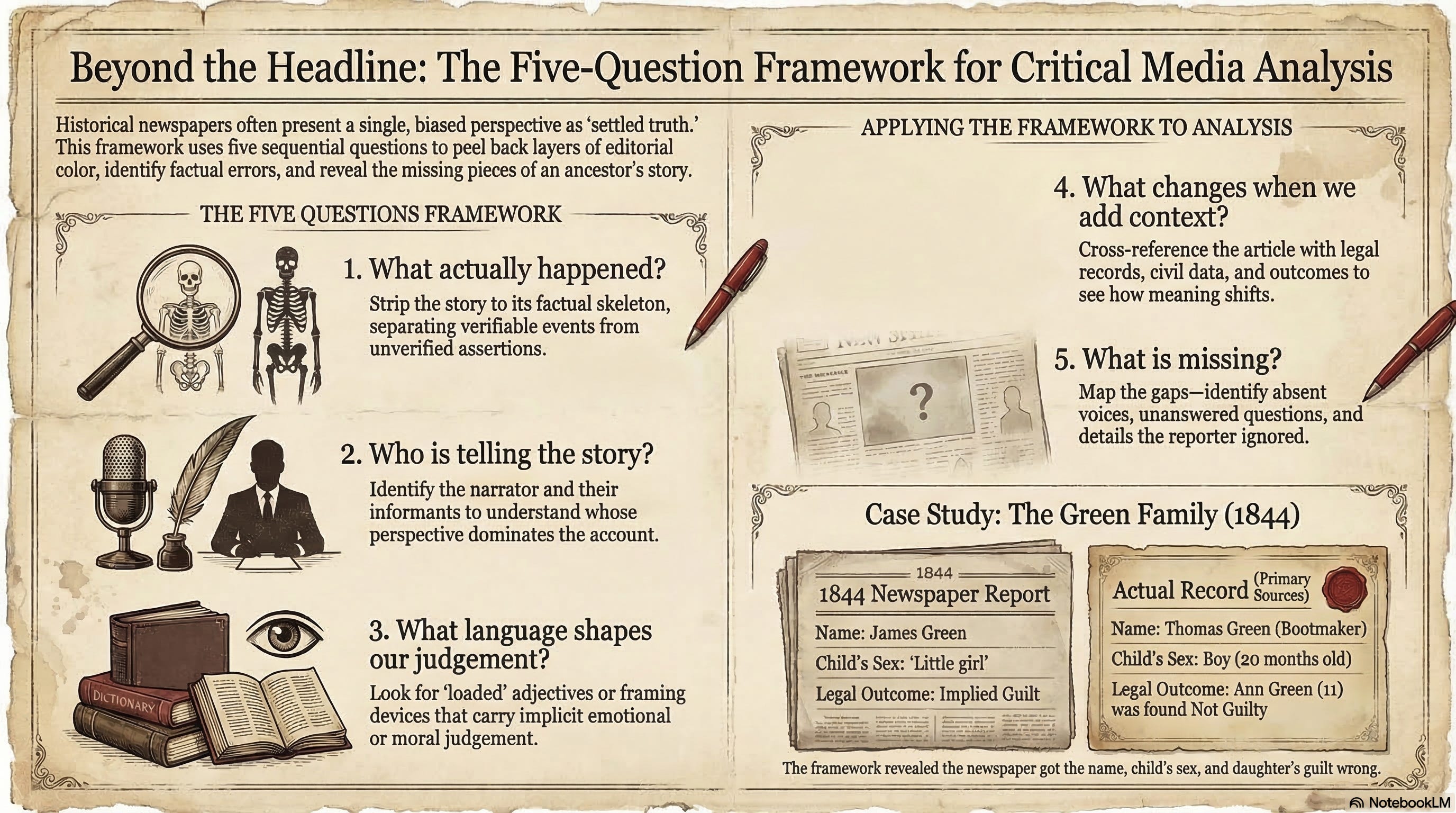
The thing is, newspapers are storytelling machines. They always have been and always will be! They select, compress, dramatise, and frame. That’s not a criticism; it’s just the nature of the medium. But for genealogists and family historians, it means we need to read them with our eyes open. Not just for what they say, but for how they say it, who is doing the talking, and what they leave out.
I already knew the story I'm about to share. I've spent years researching it and wrote a self-published book about it in 2022, In Search of Orphan Annie. But when I watched Baldwin's session, it was the first newspaper article that came to mind. I'd used it many times as a source, but I'd never sat down and really pulled it apart as a piece of narrative. Now with AI tools that help us analyse our findings, I thought, why not put this to the test. So I popped the five questions into three AI tools: Claude, Perplexity, and ChatGPT. They all gave similar responses, just in a different format. Perplexity went out and found other articles, my own included, over on my old WordPress blog where I had written about the story. But across all three, the results were eye-opening enough that I thought they were worth sharing. What came back was that a single, detailed, vivid newspaper report got the accused man's name wrong, the sex of a dead child wrong, the nature of a violent incident wrong, and an eleven-year-old girl's guilt wrong. And I only discovered all of that because I asked five simple questions. For this article, I've gone with Claude's response.
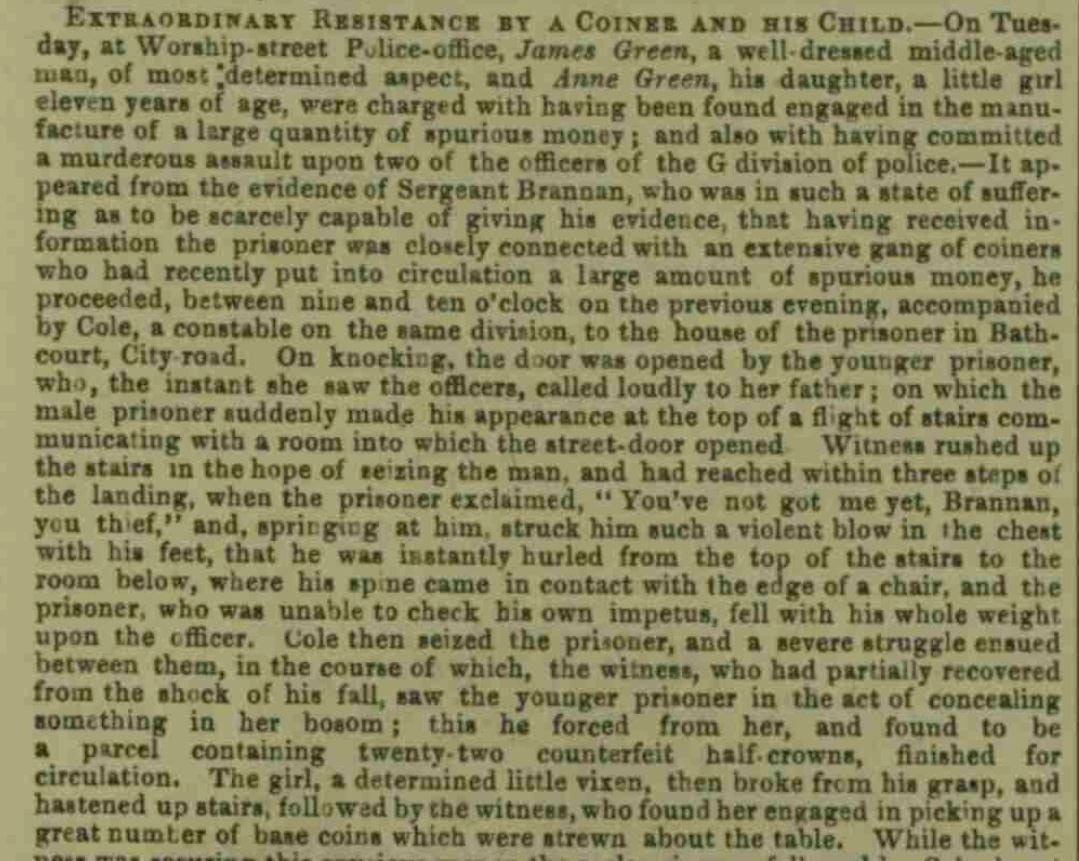
On 28 December 1844, The Illustrated London News published a vivid account of a police raid gone violent. The headline read: “Extraordinary Resistance by a Coiner and his Child.”
It told the story of a man named James Green, described as “a well-dressed middle-aged man, of most determined aspect,” and his eleven-year-old daughter Anne, charged with manufacturing counterfeit coins and assaulting two officers of the G Division of the Metropolitan Police. The article was dramatic, detailed, and utterly gripping.
It was also wrong. On several counts.
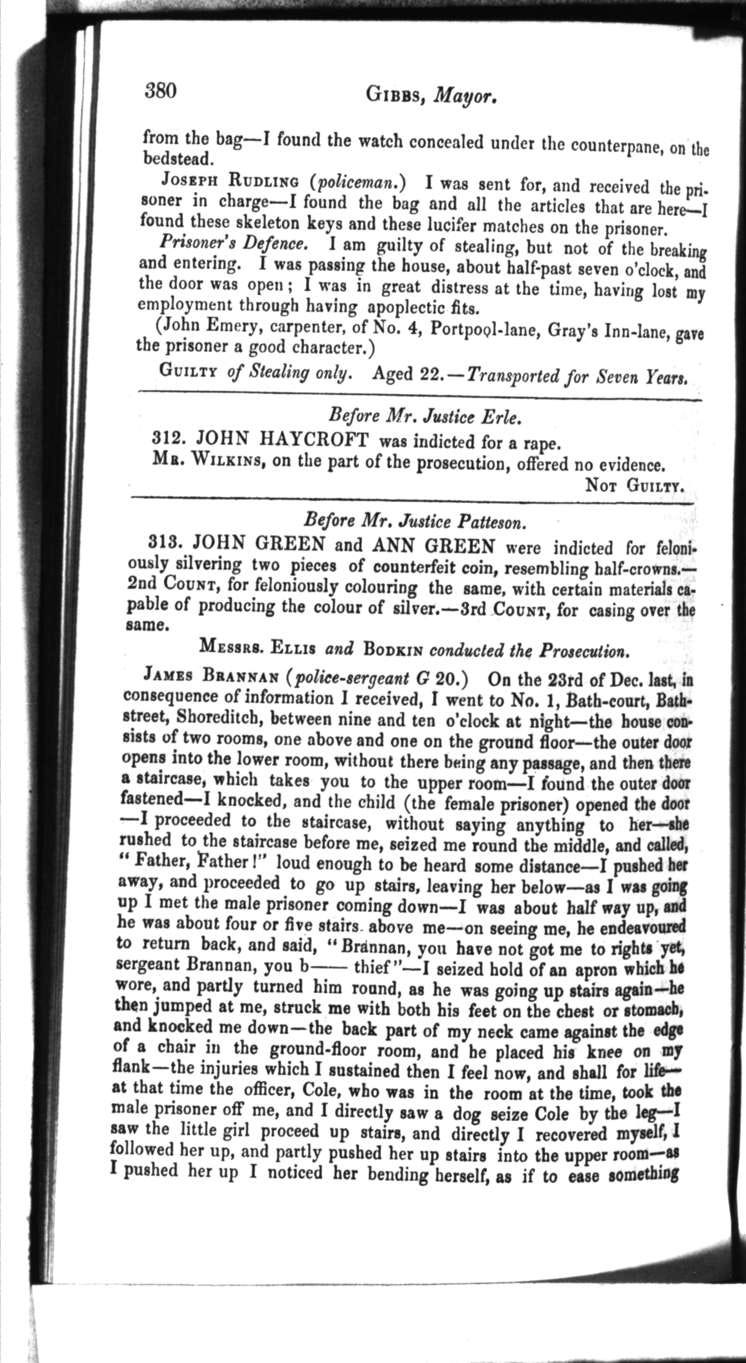
I’d already discovered that the old fashioned way, through years of reading, researching, and analysing records. When I placed the article alongside the Old Bailey trial proceedings from 6 January 1845, and added what I knew from transportation records, civil registration, and coroner’s reports, the newspaper’s version of events didn’t just look incomplete. It looked like a different story altogether.
The five questions exercise was a chance to try the framework out on something I already knew well. And what it did was lay all of that out in a structured way, making it easier to see exactly where the article failed and why. Here’s how they played out with this case.
Question 1: What actually happened?
This question strips a source back to its factual core. What can be verified? What is interpretation? What is asserted without attribution?
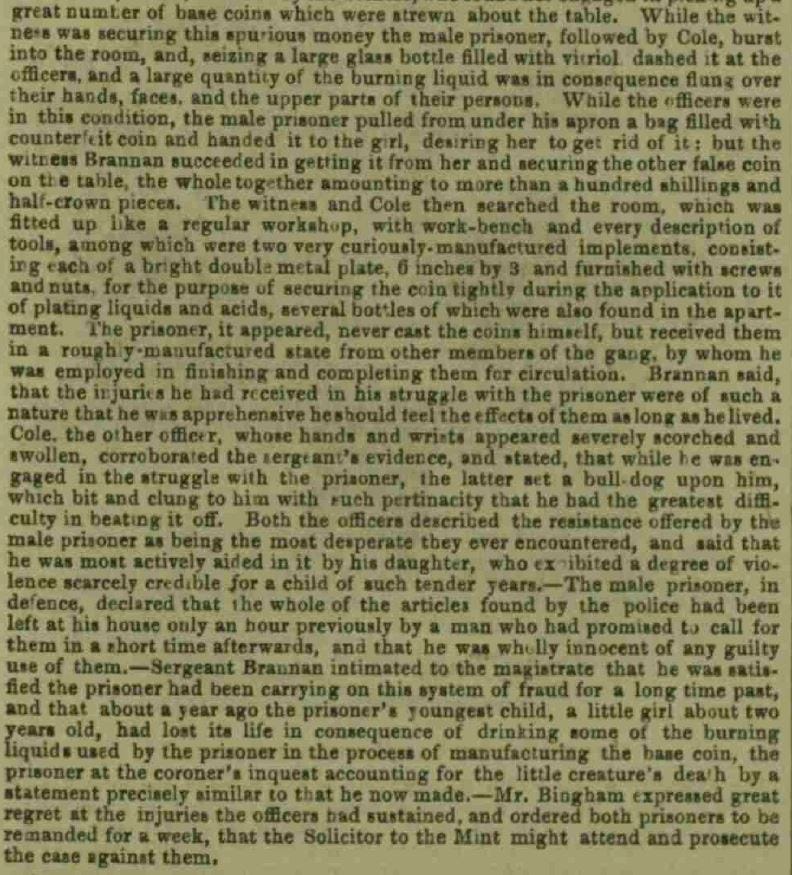
According to the article, Sergeant Brannan and Constable Cole went to the accused man’s house in Bath-court, City Road, between nine and ten o’clock on the evening of 23 December 1844. The daughter opened the door and called out to her father. The father appeared at the top of the stairs, shouted at Brannan, and kicked him down the staircase. A struggle followed. The daughter was caught concealing counterfeit half-crowns. The father seized a bottle of vitriol (sulphuric acid) and hurled it at the officers. The room was fitted out as a counterfeiting workshop. Both father and daughter were charged and remanded.
The article also mentioned that roughly a year earlier, the prisoner’s youngest child — described as “a little girl about two years old” — had died from drinking the burning liquids used in the counterfeiting process. A coroner’s inquest had been held, but the verdict was not reported.
Nearly every factual claim in the article comes from a single source: Sergeant Brannan’s evidence. No independent witness, no medical report, no expert testimony. The accused man’s defence is summarised in two sentences. His daughter is given no voice at all.
That’s a lot of narrative weight resting on one man’s account.
Question 2: Who is telling the story?
Every source has a narrator, even when that narrator is invisible. This question asks: whose perspective are we reading?
The Illustrated London News was a weekly aimed at a middle-class English readership. Its audience had strong views about law, order, and property crime. The reporter is unnamed, which was standard for the period. The account reads as a court report, likely taken from notes made in the public gallery at Worship Street Police Office during the remand hearing.
The story is built almost entirely on Brannan’s testimony, backed up by Cole. But here’s the thing: Brannan is simultaneously the chief prosecution witness, the arresting officer, and a victim of the assault. He is narrator, participant, and injured party all at once. That’s a significant conflict of interest, and the article never acknowledges it.
The accused man gets two sentences. His daughter gets none. No defence solicitor is quoted. No one speaks for an eleven-year-old girl who has just been charged with a serious criminal offence.
Question 3: What language shapes our judgement?
Words are never neutral. This question looks for loaded or evaluative language that tells the reader what to think before the facts have had a chance to speak for themselves.
The headline calls the accused a “Coiner” — not an alleged coiner, not a man charged with coining, but a coiner. He’s convicted in the headline. He’s described as a man “of most determined aspect,” framing his appearance as threatening before a word of evidence is heard. Brannan is described as “in such a state of suffering as to be scarcely capable of giving his evidence,” which positions him as heroic before his testimony begins.
But the most striking language is reserved for the child.
Annie Green is called “a determined little vixen.” A vixen — a female fox — was a common term for a shrewish, ill-tempered woman. Applying it to an eleven-year-old girl is remarkable. Both officers describe her as exhibiting “a degree of violence scarcely credible for a child of such tender years.”
That framing does something very specific. It strips away any possibility that this was a frightened child reacting to a violent home raid in the only way she knew how. It turns her into something unnatural, almost monstrous. And it does it with language, not evidence.
Question 4: What changes when we add context?
This is where the framework really earns its keep. When I placed the newspaper article alongside the Old Bailey trial proceedings and my own research, the discrepancies stood out.
The name was wrong. The article calls him James Green. The Old Bailey proceedings record him as John Green. His real name was Thomas Green, born in Limerick, Ireland, a bootmaker by trade. Three different names across three different record sets. A researcher searching only under “James” would find nothing.
The dead child’s sex was wrong. The article describes the deceased younger child as “a little girl.” The child was a boy, aged 20 months. And the coroner’s verdict — accidental poisoning — was not reported in the newspaper. That omission matters. Without it, the death hangs in the article as an implied accusation, a suggestion that Green’s criminal negligence killed his own child. The coroner’s finding tells a different story. This is my thoughts on what happened.
The violence was exaggerated. The newspaper describes Green seizing a bottle of vitriol and dashing it at the officers, as though it were a deliberate acid attack. Brannan’s sworn testimony at trial is more measured: Green reached over his shoulder, picked up a bottle, and smashed it on the table. The contents splashed onto those nearby. Green’s own defence — that Brannan pulled him down and that he never kicked the officer — does not appear in the newspaper at all.
The daughter was acquitted. This is the detail that matters most. The Old Bailey proceedings end with two verdicts. Thomas (as “John”) Green: guilty, sentenced to fifteen years’ transportation to Van Diemen’s Land. Ann Green, the eleven-year-old “vixen”: not guilty.
The jury looked at the same evidence the newspaper had dramatised and decided it did not support a conviction. The newspaper, which ended its coverage at the remand stage, left its readers with the impression that both father and daughter were destined for punishment. The court said otherwise.
Question 5: What is missing?
This last question is often the most productive one for genealogists. It asks: what does the source not address, and where should I look next?
The newspaper says nothing about the accused man’s wife. She is completely invisible. Yet Ann Green née Wright was part of this household. She would later be convicted of passing counterfeit coins and stealing lace, and was herself transported to Van Diemen’s Land. She too was convicted under an alias name! Their surviving daughters — Annie, then eleven, and Matilda, aged seven (never mentioned in the article) — accompanied their mother and were placed in the Queen’s Orphanage in Hobart.
The article mentions only two children: Annie and the deceased younger child. In reality, Thomas and Ann had six children. Only the two eldest daughters survived. The loss of four children out of six paints a picture of a family under immense hardship, a picture entirely absent from the newspaper’s framing of Green as a calculating criminal.
The article also gives no outcome. No trial, no verdict, no sentence. For a researcher, that absence is a signpost. It says: look for the Old Bailey proceedings, the Mint Solicitor’s prosecution records, the transportation lists, the convict records in Van Diemen’s Land.
Every gap identified by the five questions pointed to another record set. And every record set told me something the newspaper couldn’t or wouldn’t.
Why this matters
I’m not suggesting we throw out newspaper articles as sources. They are often the first — and sometimes the only — detailed account of an ancestor’s life we can find. But this case taught me something I now carry into every piece of research I do.
A single source is a starting point, not a conclusion.
The five questions are not complicated. They don’t require specialist training. You can apply them to a newspaper article, a court record, a parish register, or an immigration document. They simply ask you to slow down and notice what the source actually says, who is saying it, how it says it, what changes when other evidence is added, and what remains unanswered.
In this case, they revealed that a newspaper got a man’s name wrong, a child’s sex wrong, the nature of a violent incident wrong, and an eleven-year-old girl’s guilt wrong. They revealed an invisible wife, an invisible daughter, and four invisible children who did not survive. They revealed a family that was not just touched by the criminal justice system but torn apart by it, scattered from London to the other side of the world.
None of that was in the first source I found. All of it was waiting in the records that came after.
The newspaper article appeared in The Illustrated London News, 28 December 1844. The trial proceedings are available through Old Bailey Proceedings Online (www.oldbaileyonline.org), January 1845, trial of John Green and Ann Green (t18450106-313). Additional biographical data was derived from various newspaper accounts, transportation records, civil registration, coroner’s reports, and institutional records from Van Diemen’s Land.
All of the above conclusions are what the genealogy word called Genealogical Proof Standard and RootsTech shared this session which is another well worth watching.
Link to: Read more about Orphan Annie over on my Family History Archive at JenealogyScrapbook on WeAre.xyz
Thanks for this.
It also sent me off to listen to Jen Baldwin’s informative talk.
Excellent breakdown of the necessity of critical sourcing.