

I’ve been writing the stories of my mother’s paternal family, the Herberts. My uncle Ray and cousin John have done an amazing amount of research into this family over the years, but I wanted to go beyond the Herbert paternal lineage and write about the women in their lives.
While piecing together the story of James Herbert’s two wives, Susannah Barwell and Mary Conroy, I knew that his children, James Albert and his sister Helen, arrived in Fremantle, Western Australia in 1853. What stood out was that they travelled not with their mother, but with a stepmother. That raised an obvious question. What had happened to Susannah?
The answer was a sad one. Susannah died in 1846, aged just 26, at Cold Harbour in Middlesex. The cause was phthisis, what we now know as tuberculosis.
My next step was to confirm the family in the 1841 census. To satisfy the Genealogical Proof Standard, I needed to see the record for myself. It took some finding. James Herbert, aged 20, had been mistranscribed as “Sam Herbert”. On checking the original image, the name was actually “Jam Herbert”, a common abbreviation. He was listed with Susan, a two-year-old Eliza, and Mary Barwell aged 55, living in Russell Place, Westminster.
But wait. I had never come across a child named Eliza before. I knew that James and his second wife, Mary, had a daughter, Elizabeth, who died aged two during the voyage to Western Australia, so this had to be a different child.
I located and ordered her birth certificate. Fortunately, the mother’s maiden name, Barwell, made identification straightforward. One advantage of English records is that civil registration certificates can be downloaded instantly for a small fee. £3UK or $6AUS.
But this created a new problem. If Eliza existed, where was she when James remarried in 1850 and later sailed for Western Australia with his children? She wasn’t among them.
I needed to determine which, if any, of the Eliza Herbert death records belonged to this child.
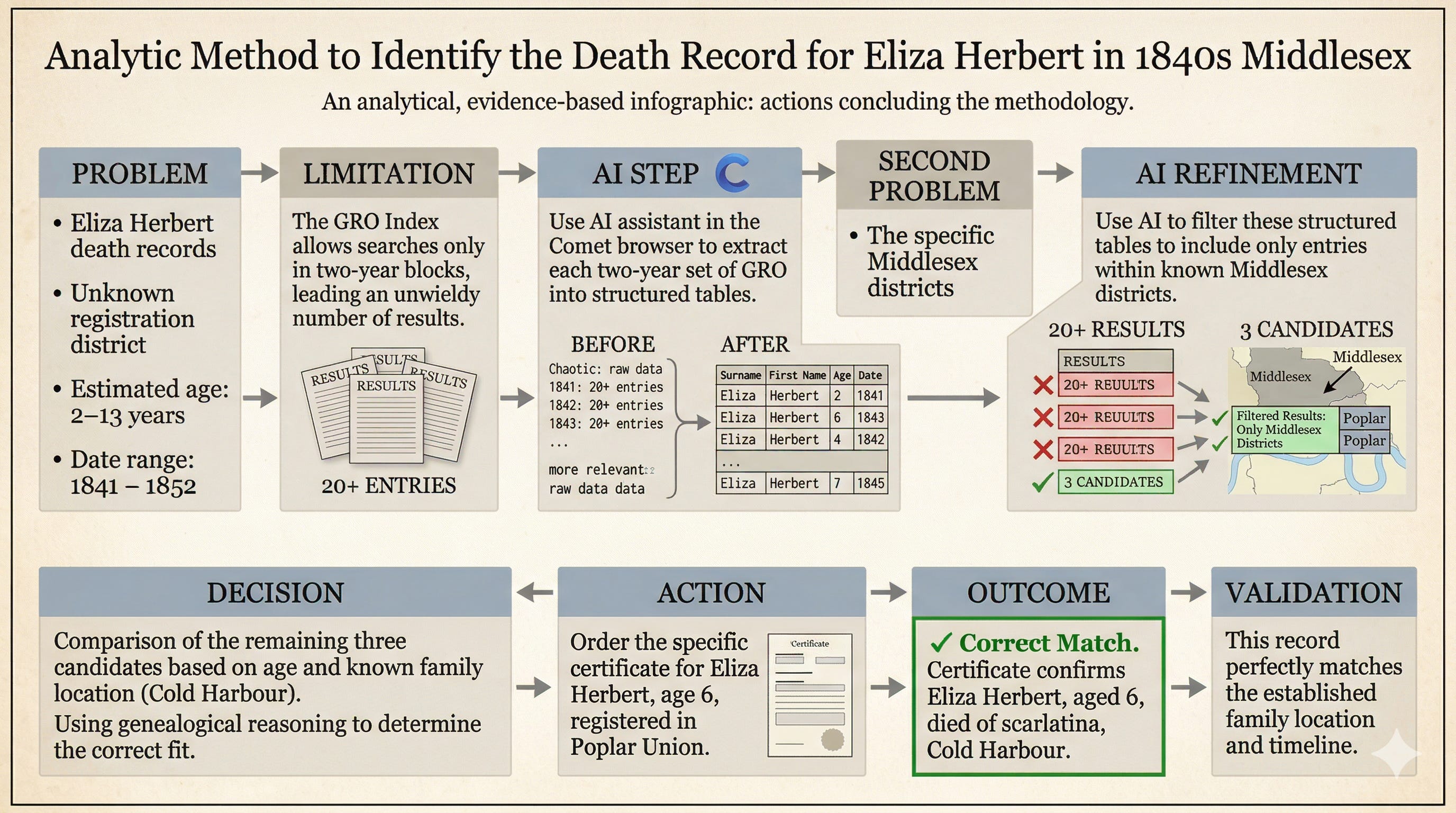
There were many. Without a known registration district, and with an estimated age range between 2 and 13, covering the years 1841 to 1852, the task quickly became unwieldy.
The GRO Index, held by the General Register Office for England and Wales, allows searches, but only within two-year blocks. That meant working through multiple results, each containing numerous entries. Manually sorting them would have been slow and error-prone.
This is where I turned to the Comet browser’s AI assistant.
Using the AI, I extracted each two-year set of GRO search results into structured tables. I repeated this across the full date range. That gave me something I could actually work with.
But there was still a problem. I didn’t know which registration districts fell within Middlesex, so I couldn’t easily narrow the list and the GRO Indexes only have a filter for the registration district, not the county.
I then asked the AI to filter the tables to include only entries within Middlesex.
That single step reduced the list dramatically, from a large pool of possibilities down to just three possible Eliza’s.
Now I could apply genealogical reasoning.
I compared the remaining entries by age and location, looking for the best fit with what I already knew about the family.
I decided to order the certificate for Eliza Herbert, aged 6, registered in the Poplar Union district.
Bingo! First go and it proved to be the correct choice.
Eliza Herbert, aged 6, daughter of James Herbert of Cold Harbour, had died of scarlatina, or scarlet fever, in 1845.
So that answered the question. Eliza did not travel to Western Australia because she had died the year before her mother.
Then came the detail that brought it all into focus.
Cold Harbour kept appearing. It was on their daughter Helen’s birth certificate in December 1843, on Eliza’s death in 1845, and again for Susannah in 1846. That was enough to confirm I had the right family.
Within the space of a year, James Herbert lost a child and then his wife, likely only a few steps apart.
It puts his remarriage, and the later voyage to Western Australia, into a very different light.
A small note on method. I could have used the FreeBMD index, but it does not include ages, whereas the GRO index does. In this case, that detail made all the difference. It’s a useful reminder to check what each source actually offers.
The key point here is that AI did not solve the problem on its own. It structured the data, reduced the possibilities, and made the task manageable. The final decision still relied on careful comparison and genealogical judgement.
And sometimes, it’s the child you didn’t know existed who tells you the most.
A huge shout out to Carole McCulloch the Essential Genealogist for introducing me to the Comet browser and all things AI. Check out Carole’s YouTube videos and the Essential Genealogy Academy where you can learn all about creating meaningful stories about your ancestors using AI.
More stories about the Herbert family can be found on my WeAre .xyz family history archive at this link: Jenealogy Scrapbook
Really interesting to see your process.
I need to use AI to see if it can help me break down a brick wall or at least narrow the search. Thank you for this article.